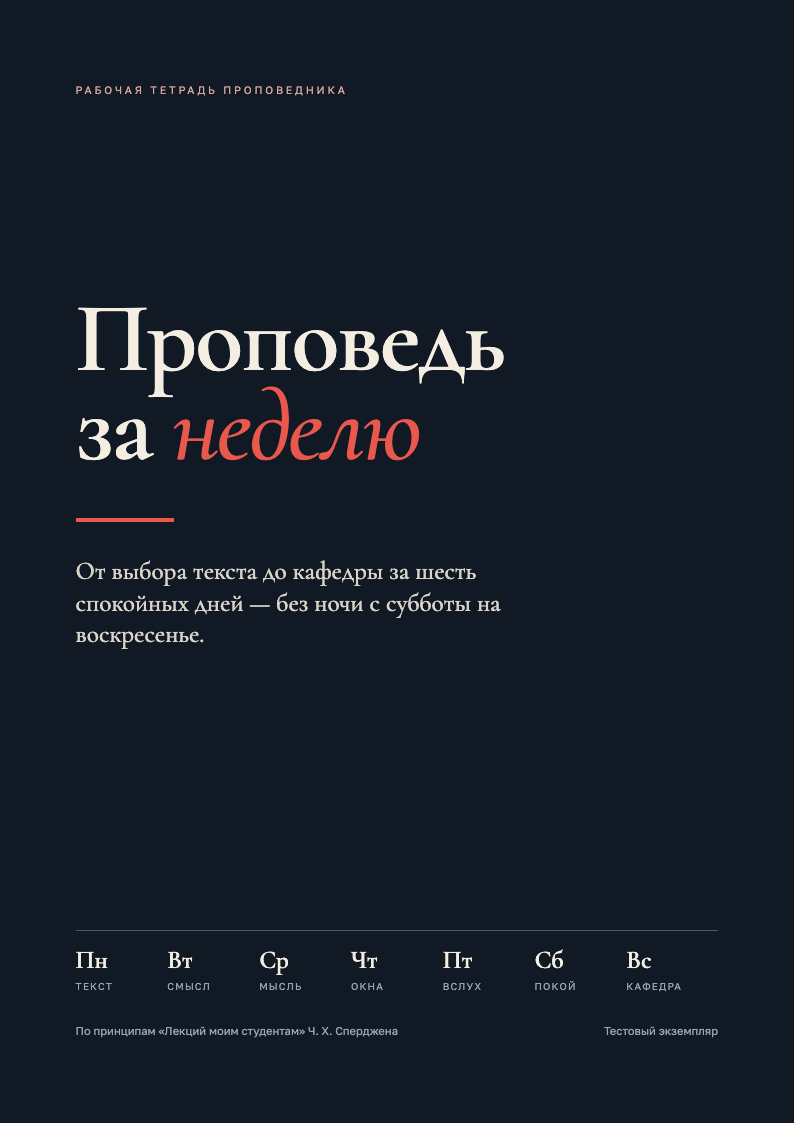
How to prepare a sermon in a week
Six calm steps from choosing a text to stepping into the pulpit — for those who preach without seminary training and without a sleepless Saturday night.
16 pages · prints on any home printer
- Six daily pagesOne task a day, with space to write
- Pulpit sheetThe whole sermon on a single page
- After-sermon reviewSo the next one is stronger
Each day has one task and one written result
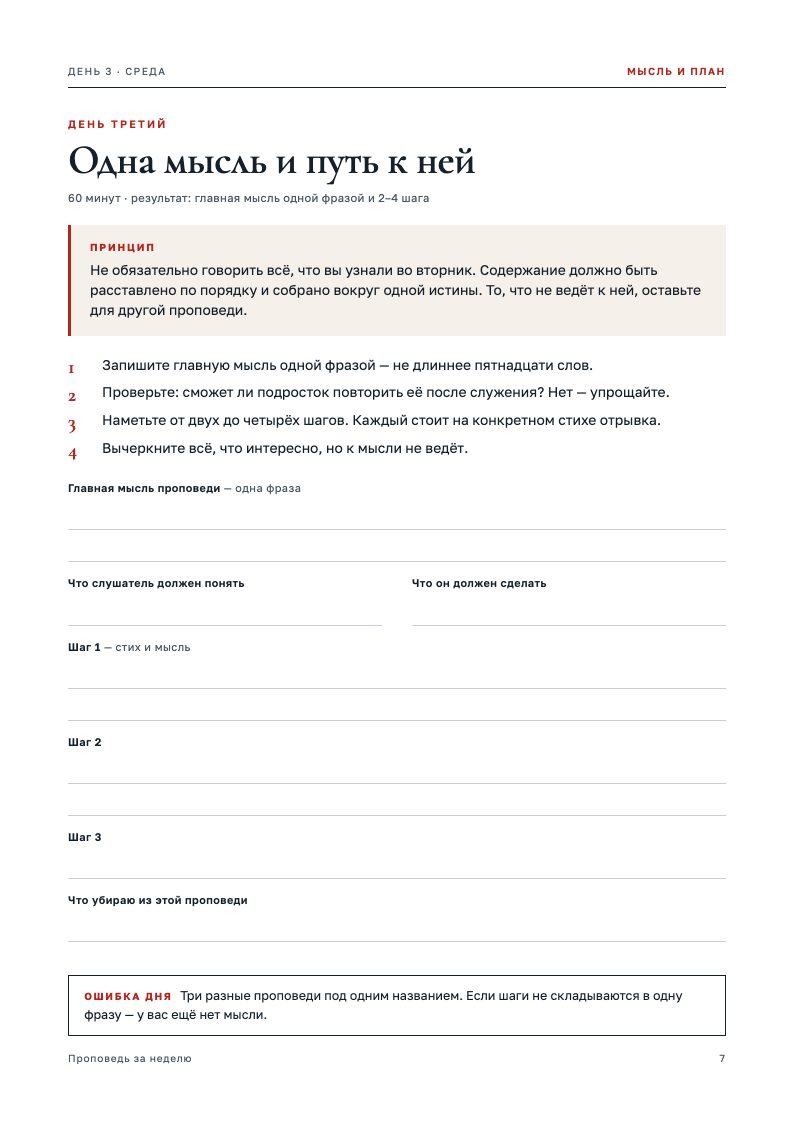
The same hours you spend now, only spread across the week. Every day has its own page: a principle, four actions, space to write and a typical mistake to avoid.
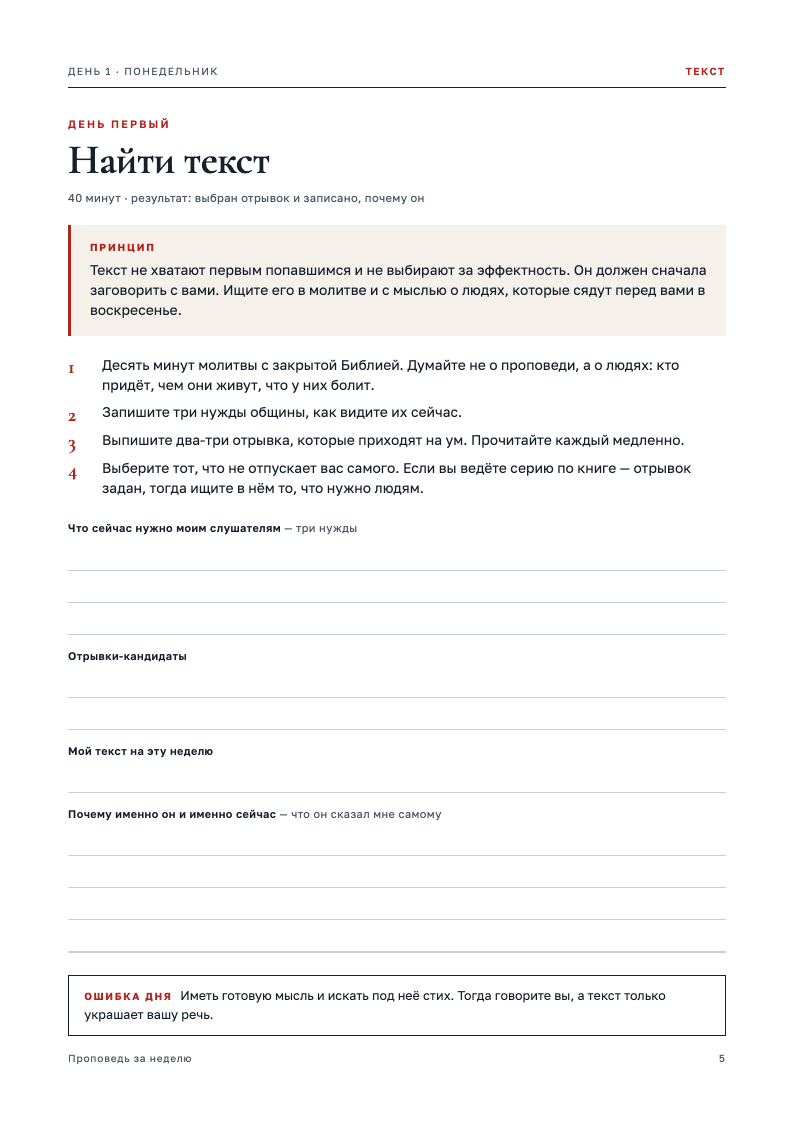
- MonTextPray for your people and choose the passage that has gripped you first40 min
- TueMeaningWhat the author said to the first hearers. Commentaries come last60 min
- WedIdea and outlineOne sentence and 2–4 steps towards it, each resting on a verse60 min
- ThuIllustrationsA picture for each step, your first and last sentences, the call45 min
- FriOut loudA standing run-through with a timer and a recording. Then cut45 min
- SatRestPrayer, the 12 questions, the pulpit sheet and sleep20 min
- SunPulpitYou preach. On Monday, a 15-minute reviewsermon
Not a book about preaching — working sheets
There is very little to read. The workbook asks questions and leaves room for your answers.
- p. 3Seven principlesWhat the week stands on, on one page
- p. 4Map of the weekWhat to do each day and what should be written down by evening
- p. 5–10Six daily pagesText, meaning, idea and outline, illustrations, run-through, rest
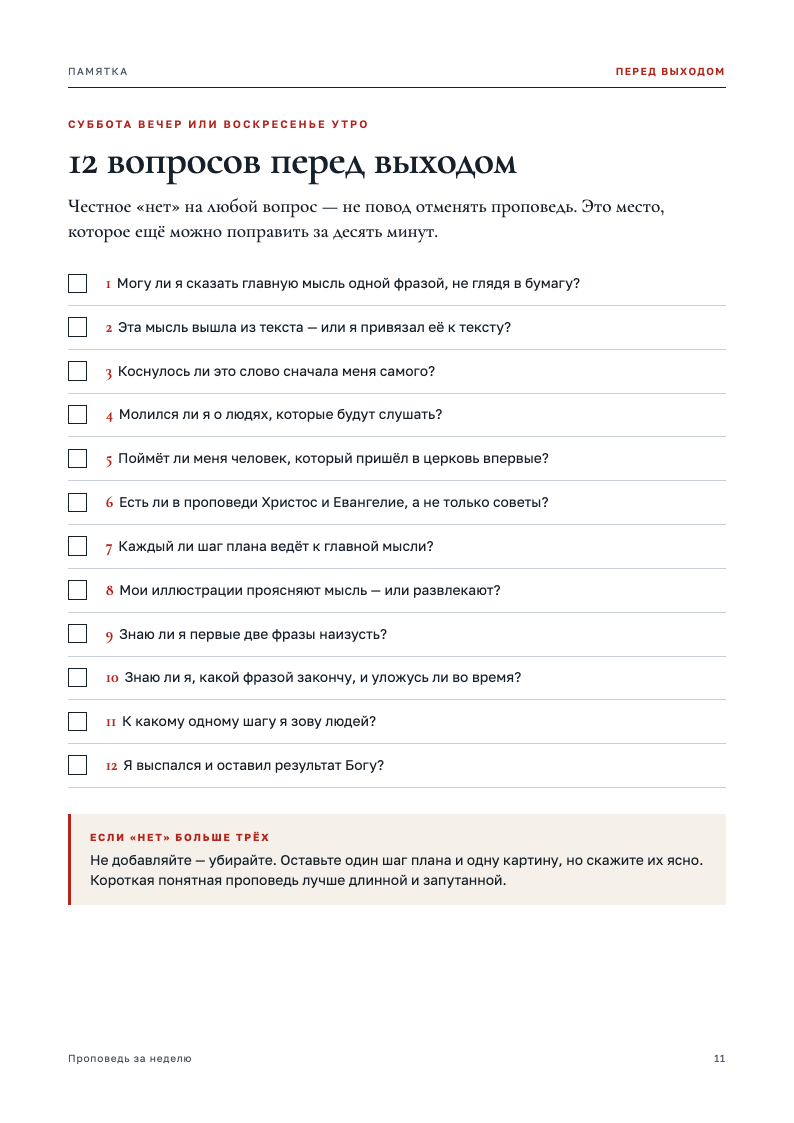
- p. 1112 questions before you preachA ten-minute check of your sermon
- p. 12Pulpit sheetThe whole sermon on one page instead of a stack of notes
- p. 13Nine reasons people stop listeningAnd what to do about each
- p. 14After-sermon reviewFifteen minutes on Monday to make the next one better
- p. 15When it is hardFew books, little strength, a lot of criticism
A sermon grows weak at the desk, not in the pulpit
What fails a preacher is not the voice or the gift of speech, but what was left undone during the week: the text was never really read, the one main thought never found, the sermon never said out loud. Energy and inspiration cannot cover that emptiness, and listeners hear it. The workbook walks you through these steps day by day, so that on Sunday you bring a prepared word instead of hoping for a moment of inspiration.
«Your people need discourses which have been prayed over and laboriously prepared. People do not want raw food, it must be cooked and made ready for them.»
The text is chosen on Friday
And often on Saturday. There is no time left to understand the passage, so the sermon fills up with general words that would fit any verse.
Many thoughts, no main one
Much of what was said is true, but after the service people cannot tell you what the sermon was about.
Spoken aloud for the first time in the pulpit
Hence the extra twenty minutes, the lost ending and a room that stopped listening halfway through.
Seven principles the week stands on
They have been tested by generations of preachers — including those who had neither a university degree nor a large library. In the workbook each principle becomes concrete actions for a specific day.
The preacher first, then the sermon
Caring for your own soul is part of preparation, not a distraction from it.
The text is found in prayer
You look for it thinking of your people, not of what will sound impressive.
A sermon must have something to feed on
Substance from the text matters more than fine speech.
One idea they will carry home
Ten ideas are forgotten by lunch; one is remembered.
An illustration is a window
It lets light in, but no one builds a house out of windows alone.
Attention is the preacher's responsibility
If people are not listening, question yourself first.
Voice and body serve the word
Your own voice persuades more than rehearsed techniques.
For yourself, for your church or as a gift to a minister
A one-time payment. The file arrives by email at once, and you may print it as often as you like.
For one preacher
- PDF workbook, 16 pages
- Unlimited printing for yourself
- Free updates to the workbook
For a church
- For everyone who preaches in your congregation
- Print and share within the church
- A 90-minute session plan for working through it together
Gift to a minister
- Enter the email of the person you are giving it to
- They receive the workbook and your note
- A gift for a pastor or a missionary
Sermon preparation in brief
How do I prepare a sermon without theological training?
Split the preparation into six short daily steps: choose the text, understand its meaning, state one main idea and an outline, find illustrations with an opening and an ending, speak the sermon aloud, and rest before Sunday. Each step takes 30–60 minutes. A Bible and careful reading are enough.
How long does it take to prepare a sermon?
With the workbook, about four and a half hours spread over six days: from 20 to 60 minutes a day. What matters is not the number of hours but that they are not squeezed into one night before the service.
How do I write a sermon outline?
First write the main idea in one sentence of no more than fifteen words. Then sketch two to four steps, each resting on a specific verse of the passage and leading to that idea. Remove everything that does not lead to it.
How do I keep the congregation's attention?
State the main idea at the start, announce each new step, give one illustration per step, vary the pace and volume of your voice, use pauses, and finish while people still want to listen.
How do I end a sermon?
Write your last two sentences in advance, word for word. At the end repeat the main idea and name one concrete step you are calling the listener to take. Do not introduce new ideas in the conclusion.
Will the workbook suit my church and tradition?
The workbook teaches not theology but the craft of preparation: how to work with the text of Scripture, build an outline and speak clearly. It suits evangelical churches of different traditions.
In what format will I receive the workbook?
A PDF file. You can print it on an ordinary black-and-white printer or fill it in on a tablet. One sermon needs nine sheets: six daily pages, the 12 questions, the pulpit sheet and the review.
Your next sermon starts on Monday
Print the workbook today — and step into the pulpit on Sunday at peace.
Get the workbook — $14